Peas and Hearts

Intensive week ended, and it’s bittersweet.  Of the all the kids we taught to blog, two have been keeping up with it into the next week post-intensive.  Yay Celeste and Cathy!  The school year is winding down, only 16 days till my kiddos take their Living Environment (biology) regents exam.  Regents exams are a double whammy: kids have to score a 65 or above to graduate, and my performance as a teacher is evaluated based on how many kids pass.  So what happens?  I stress out insanely about getting through all the material and the last few weeks are a mad dash to get through the standards.  Also, I stress out about the kids who are failing the class, which is attributed to a lack of motivation to complete assignments obviously is becasue my curriculum is not engaging enough nor is it rigorous enough.  Since apparently good teachers know, there is a correlation between increased rigor and engagement/buy in.  Seriously, I’d like to see the data for that.  I have my own informal data from my classroom and it shows that the harder I make an assignment, the less the students are motivated to complete it.  I wish that wasn’t the case, but it is.  I just don’t know what the answer is.

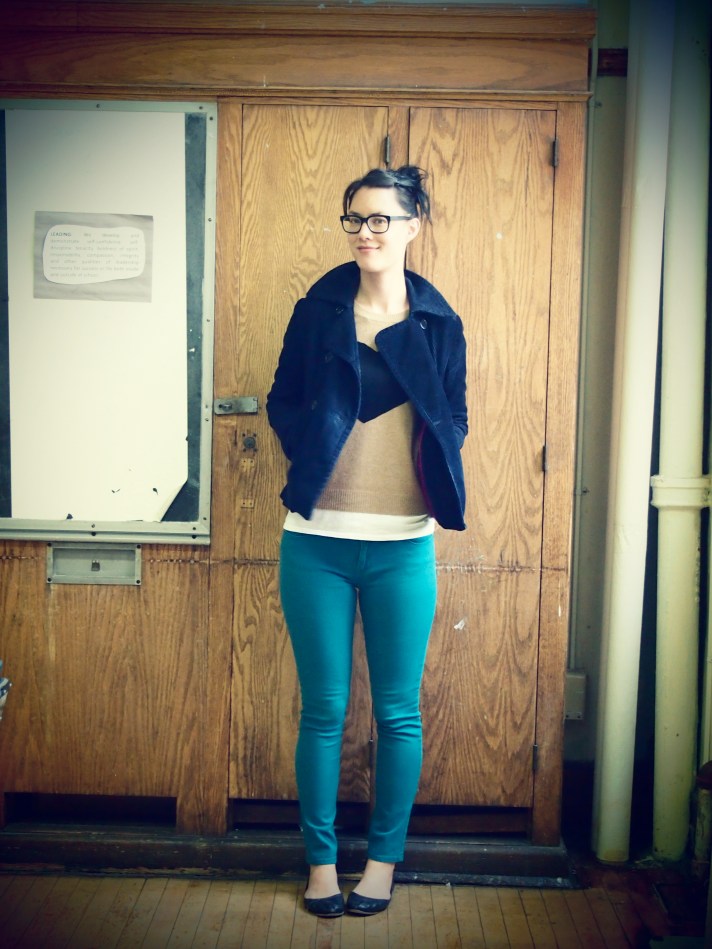
I’m going off on a depressive tangent here, so I’ll stop and instead write about a shallower topic…clothes!  I’ve love, loved this corduroy pea coat for the past 8 or so years and it’s about to get packed up for the summer.  I love the cut and how the collar pops up when I button it – keeps my long neck shielded from the wind.  peas

peas2

peas3

peas4

glasses: warby parker – coat: super old gap – sweater: old j.crew – jeans: old f21 – shoes: frye

Progress

Today was progress report day.  I gave each and every student a print out showing learning targets and their progress towards meeting them (aka did you do your assignments).  It was a huge hubbub and I’m now officially the most unpopular teacher at school.  The kids were in a tizzy and I even had 2 students storm outside for a break in the hall to collect themselves.  It’s appalling to me how many students come to school every day and still manage to complete absolutely zero assignments – no classwork, no lab, no quizzes, and most definitely no homework.  For some reason or another (I’m still mulling it over), this quarter has been an especially bad one.  In one class out of 30 students, only 7 have a passing grade or higher.  That means even if I “discount” students who never show up, I’m maintaining a 30% passing rate.  I have an abysmal HW return rate – they just don’t do it.  I also expect students to not only do their work, but to do it well and according to the guidelines of the assignment.  I don’t give credit for “effort”, meaning if I ask about osmosis and they scratch something out about Osmosis Jones, I don’t take it.

So this begs to question, “What am I doing wrong!?”  By the end of my third section of Living Environment class, I’d fallen into a pit of self-doubt.  After all, if so many kids are failing, it MUST be me and NOT them.  I’m doing something wrong, I need to change something.  Is that true?  Or have I been brainwashed by all the anti-teacher rhetoric floating around out there?  These grades (or lack of grades, rather) has weighed heavily on me all day, so I went searching for answers.  I gave my classes time to air grievances and make comments, I conferenced with my co-teacher and I even sought advice from my administrator (“let me think about that one…”).  This is what I learned today:

Student #1: “You grade too hard miss!  I struggle in all my classes, but yours way more than others!”

Student #2: “You’re too strict!  I worked so hard on this and you still only gave be a 2.1 (we use standards based grading where 1=not meeting the learning target, 2=approaching the target, 3=meets the target and 4= excels at the learning target)!

Student #3: “You give too much work!”

Student #4: (to another student, right in front of me) “I can’t even listen to her talk right now, I’m too pissed.  Ugh, she needs to just shut up!”

Student #5 “WHAT? This is mad f-ed up!  I do all my work!”

-I should have other teachers grade my lab reports and compare scores.  Maybe I am too strict with grading.  I use a rubric, which the kids have a copy of.  Maybe I need to ease up on sticking to it.

-I need to ease up on assigning homework, and/or I should not count all of them, just some.

-The kids thought I was laughing at them sinisterly when in fact I was trying to force a smile while they were all voicing their discontent.  My uncomfortable smile apparently = evil I’m-out-to-get-you laugh.  Crap.

-I just need to ease up in general.

In my defense, this is how I help support my kids academically with their work:

-I scaffold the shit out of every assignment I give by outlining reports for them, giving them graphic organizers, vocabulary instruction, etc.  I practically hold their hands through every assignment.  My co-teacher even created a “fill in the blank” lab report for my SPED (special-ed) and ELL (English language learners)!

-I give written feedback on every assignment I hand back.

-I’m available at any hour of the day for tutoring or help in person, over email or even by phone.  The kids have all my info, for real.

-I allow practically unlimited time for turning in assignments.  I accept any and all late work up until the day before grades are due.

-I allow for revisions: If a kid is not happy with his/her grade, they can revise their work (based on my feedback) and re-submit it.

-I assign work that is within their reach with realistic timelines (I think), such as “write a paragraph on whether or not the BRCA gene should be patented, using my given topic sentence”.

So, what do you guys think?  What do I need to change?  How can I up my passing rates without compromising my ethics and just pushing kids through?  My grade team had a discussion around broken grading practices and how to fix them last monday.  I need to continue the discussion.  Please help.

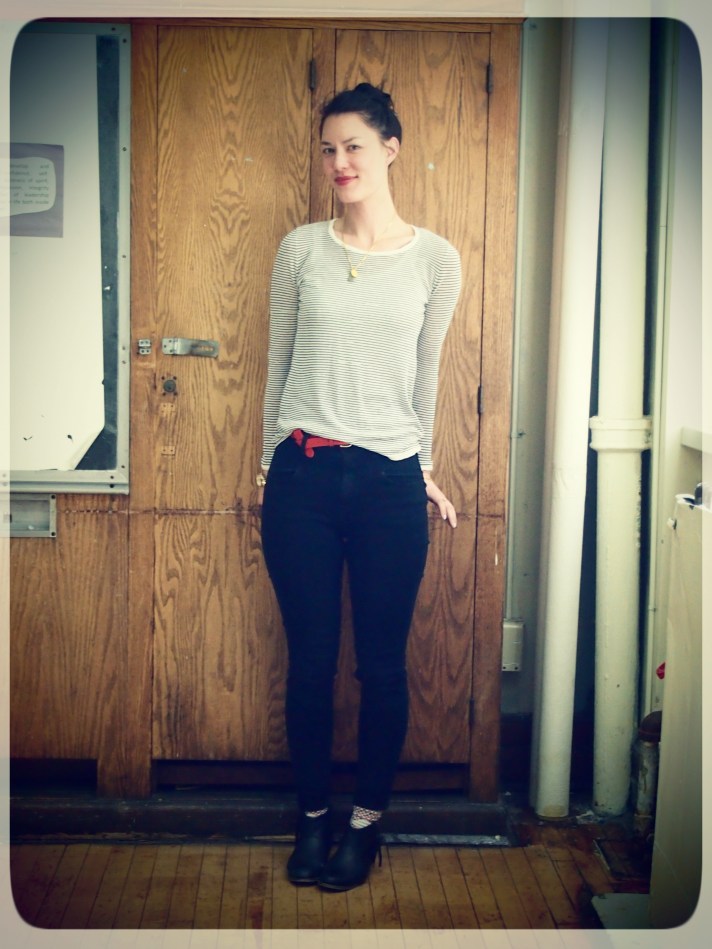
In the meantime, here’s what I wore today, pencil in hair, sinister smile and all.

Progress

Progress2

Progress3

Progress4

shirt: madewell – belt: j.crew – jeans: bdg – socks: juicy couture (gift from my sister years ago) – boots: steve madden – necklace: my popo via mommy

Data

The other day, David Brooks of the New York Times published a short piece, The Philosophy of Data, on the current prevailing mania for “data-ism”.  This op-ed strikes a chord with me, as this “data-ism” is something I have seen in public education for as long as I’ve been teaching (which is just a paltry 4 years).  This data-driven mania is prevalent on both coasts – with San Francisco Unified School District and with the New York Department of Education.  I’m willing to bet that it’s the same with most other large school districts and probably trickling down into the smaller ones too.  When I started teaching, one of the first things I was told (or was implied to me) was that data was the be-all, end-all, and that it was a measure of how good a teacher you are.  I mulled that over my first year and initially agreed – we enjoyed a double digit increase in percentage points of the STAR test that year – but I was always skeptical of the implied causation of the results.  I don’t think I was a very good teacher at all my first year.  In fact, I’d say I was horrible.  David Brooks’s article touches on this skepticism for data driven strategies.  He says that there is no evidence that teaching to students’ learning styles gets results.  Does this mean it’s OK to not break my neck over trying to tailor everything I do to all the different student learning styles?  Blasphemy!

I confess I enter this in a skeptical frame of mind, believing that we tend to get carried away in our desire to reduce everything to the quantifiable.

…many teachers have an intuitive sense that different students have different learning styles: some are verbal and some are visual; some are linear, some are holistic. Teachers imagine they will improve outcomes if they tailor their presentations to each student. But there’s no evidence to support this either.

This philosophy of using data as absolute proof has so many implications for what I do every day in the classroom.  For example, the big thing in SFUSD is using data to inform your instruction (if I had a dime for every time I heard those words…).   In an effort to help us teachers inform our instruction, and to hold us accountable, our school implemented mandatory “accountability and assessment meetings”, where we had to show data from an assessment and talk about how we plan to act on the information we get from the data.    The district licensed the use of a handy program called Data Director, which took our (mostly multiple choice) test questions, aligned them to the state standards, and spat out a statistical analysis of how our students performed after we scanned in the answer sheets.  Sadly, this sort of cool efficient technology is not available to me here at the NYDOE – I have to spend hours entering in answers to an Excel spreadsheet to run my own analysis.  What a time-suck.

I had a love/hate relationship with Data Director.  It made test grading super fast and easy, allowed me  to design assesments with a variety of types of questions and did all the analysis for me.  I could look at performance across a class, across a grade, special population students, every which way.  The data was super informative and clued me into things I probably would have missed otherwise.  I could see what questions students struggled with the most and what answers were most popular, allowing me to clear up misconceptions right away and re-teach only the most important or commonly missed topics.  I was also able to be transparent with this data and show the students their own numbers, their class data, and how they compared to the other Biology sections.  This transparency was a huge boon to my instruction.  For kids who thrive on competition, they could reflect on where they stand when compared to others.  For kids who are self motivated and benefit from quiet reflection, they could see  which topics they needed to study more or get tutoring on.  Students who just didn’t give a shit could see that many of their peers did in fact give a shit (thus motivating them to actually give a shit – in theory).

While I love seeing data, it continuously serves as a slap in the face.  It crushes my confidence, it depresses me, it pisses me off and makes me disappointed in my students.  It also tells me that I’m a crappy teacher who shouldn’t even breath the same air as my administrators, because we’re all made to feel (or just I feel on my own) that they could have gotten better results.  I get anxiety when I analyze my data.  The take home message that is continuously driven into our psyches is that if our students aren’t performing, it’s because we’re doing something wrong.  Plain and simple, if your students are not acing your tests, it’s because you’re a bad teacher.   This alone is enough to drive anyone into a stress and anxiety induced breakdown.  And what does the data also show, that for some reason is not talked about as often?  That many teachers do not last past 5 years.  Who would, when the measure of your success is wholly dependent on the performance of your students, regardless of all the other variables that come into play when educating kids?

These variables that are most of the time completely out of teacher control include but are not at all limited to: the amount of time students spend studying, whether or not homework was completed (I have an abysmal HW return rate BTW), and how motivated students are by test taking (and grades).   These variables are just the tip of the iceberg, not even grazing the surface of the plethora of emotional/social/economic issues our students face.  This lack of control renders tests (especially these standardized tests like the STAR test in CA and the Regents exams in NY) completely unreliable and invalid.  For more on this issue, check out this blog post, called “Don’t Buy the Snake Oil“, written by Lisa Myers, the same teacher who also inspired this post.

Our educational system is data driven – I know that and I accept it, even if i don’t like it.  Kids in every state have to take standardized tests, whose data then gets used to label schools as good or bad, teachers as effective or ineffective.  Thus, I find that I am forced to play by those rules.  This means preparing my students for those tests and using data.  If my data tells me that my class average on a practice Regents exam is 50%, I freak out for a couple days, then I get rational and relax.  After all, kids only have to score a 45% on the test to be considered “passing”.

I’m all for data in terms of it’s informational purposes.  I’m completely against using data as a metric for the worth of a teacher.  I can and will use data to see where I need to go back and teach differently.  But if that data is going to used to compare me against another teacher who does not have students who show up sporadically, with a 2 year old waiting at home, and then sleep through entire lessons then I call bull shit.  And don’t you dare tell me that kid is sleeping because my lessons aren’t exciting or engaging enough.   I put on a song and dance for every lesson.

Data is not everything, something teachers have always known.  For once someone else is also talking about it.


2/25/13: David Brooks wrote a follow up to the discussion on data, titled What Data Can’t Do.

Nerdy Stress

Today was one of those extra anxiety ridden stressful days, the type that make you feel like you just ran a mental marathon.  I had visitors in my class today – 7 adult visitors.  These visitors were administrators, “school designers” and various instructional specialists from the network (whatever that means), all in my class to observe literacy elements in the science classroom.  Of course, I was told that the visit was “in no way evaluative”, and in fact, “don’t plan anything special, just do what you would normally do”.  Yeah right.  Lets be honest, every visit is evaluative – especially when the focus is on common core literacy: reading, writing and speaking (not to mention science).  So I planned a lesson where the kiddos would be writing analytical paragraphs about the results of the lab they just finished (the conclusion, essentially).  The lesson was all set to go, when I panicked and decided it wasn’t good enough.  So I re-planned.  They needed an example of a decent paragraph and a checklist, so I made one.  They analyzed the example conclusion I wrote and critiqued it.  Then I gave them copies of paragraphs written by their peers in other sections to analyze and critique.  Finally, they revisited their own conclusion paragraphs that were written last week from a previous lab (which were abysmal).  All this went down and I tried to split myself into 37 pieces, monitoring every single kid and watching how each of the adults interacted with my kids.  It’s a controlled chaos.  Multiply this by 2 classes, and then add on top of it all an afternoon school wide “presentation of learning” where I had to create a visual representation of the course I teach and man my table with students from my classes (fingers crossed that they didn’t embarrass the hell out of me and were able to articulate what they learned from my class).

Here’s the thing I hate most about these lessons – while these lessons are absolutely necessary, I find myself forced to teach more English than I am teaching science.  I don’t like teaching English, I like teaching science, darn it!  The kids want more doing, more lab time, more fun stuff, less reading, annotating and “rigor”.  But instead, I’m forced to do all this literacy stuff with them, the same stuff they do in English class, history class, etc.  They hate it, I hate it, but it’s necessary.  Necessary because these kids can’t write a decent paragraph to save their lives (these are 15 year olds), and you know, “it’s not evaluative or anything”.

The best evaluation I got today?  A comment from a student on how my style is always changing.  “You know, one day you’re all ‘classy’ and the next day you’re all nerdy looking.”  Ummmm, thanks?  Here’s my “nerdy” look.

nerdy5

nerdy3

nerdy

nerdy2

nerdy4

sweater: cö via uo – shirt: levis – tank (underneath): alternative apparel – jeans: bdg via uo – flats: old old old nine west (these live in my class for days where I wear my bean boots to school) – bracelets: mainsai (present from b) and unknown chinatown jewelry shop (present from my popo when I was a kid)

double down

It’s a double down week.  This is my typical clothing strategy…wear the same thing all week with a dress or two in between to break it up.  It cuts down on laundry, something I actually have to be conscious of here in NY, where I have to lug laundry out of the building.  This week is a perfect example of that strategy.  Monday: Forever 21 stretch jeans and a hoodie (staff PD day, no kids),  Tuesday: dress, Wednesday and Thursday: Forever 21 stretch jeans and a creamish/whiteish topper.  Also, we’ve been in the lab this week, working on a 4 day procedure aimed at demonstrating osmosis and diffusion with onion cells and dialysis tubing.  It’s been fun and I love lab days – but the heater has been stuck on “broil” in the lab room.  Oh hello, extreme temperature changes!

Exhibit A of double down: Wednesdaydouble down

double down2

double down3

Exhibit B: Thursday

double duty2

double duty

Pardon the cheesy “hands on hips” pose.  I don’t know what I was thinking.

Wednesday ~ shirt: tobi – necklace and jeans: f21 – belt: h&m

Thursday ~ (old) glasses: salt – sweater: (old) anthropologie (last seen here)- jeans: f21 – belt: h&m – shoes: minetonka

Due Dates

Today was a big day in my class – our first full lab report was due.  Remember those?  All those sections: introduction, materials and methods, data and results and conclusion.

Lab reports are not easy for 15 year olds, so I built in a lot of hand-holding and supports for my little young adults. I assigned it 2 weeks ago and had daily “check for understandings” for the due date.  I gave them an instruction sheet, an outline, and an example lab report to look at. I gave them a lab report template where all they had to do was complete the sentences. I gave them time in class (2 class days) to work on it and I made myself available every day after school and via email to help them.

Today was the big day.  I hold in my hand 10 complete lab reports…out of 85 students.  FAIL.

I did gather a few NOT AMUSING excuses though. Real gems:

“I didn’t know it was due today!”   FACE PALM

“Lab report?  What Lab report?”   DOUBLE FACE PALM

“I need help on it!  can I come after school to get help?”  YOU’RE WAITING UNTIL THE DAY IT’S DUE TO ASK FOR HELP!?!?!?

“Oh, I didn’t get it.  I don’t understand it.”  FOR REAL?!?!

“Oops.”  FACE PALM

“Can I give it you you tomorrow?”  YES

“Can I email it to you tonight?”  YES

Crew Camping

As some of you may already know, I spent all of last week on a camping/backpacking trip with my crew.  That’s right, 5 whole days with 12 teenagers.  Our school is an Expeditionary Learning network school (we are not a charter school, though I think a few others are), and we are also an NYC Outward Bound school.  These are two overlapping programs here in NYC that are pretty intertwined, one setting the tone for curriculum and management of the school while the other offers outdoor opportunities to help develop character in our students.  This week-long camping trip to Sharpe Reservation (part of the Fresh Air Fund) is taken by all 9th graders with their crews (their homeroom for the next 4 years) and focuses on outdoors skills, leadership, communication and teamwork simultaneously.

New York couldn’t have been any more gorgeous for our trip.  In 5 days, my crew and I backpacked for 2 nights (in the rain), completed 2 high ropes elements, 3 low ropes elements and hiked about 6 miles.  In between, we sang songs, played games, settled differences, mediated drama (teenage hormones), learned how to properly poop out in the woods, laughed and cried (me – once, out of frustration).  We couldn’t have done it all without our two incredibly patient guides, Bill and Julia.  I owe them my gratitude for keeping me sane.  I love the outdoors/camping and I love my crew.  Those are two things that were completely mutually exclusive for me…’til last week. I survived!

Check out the Outward Bound blog for more on our trip and for photos with student faces.

surviving tuesdays

How to survive a hectic Tuesday at school after a 3 day weekend:  an easy no-iron shrunken boy shirt and black super stretchy jeans.  It will take you 5 min to get dressed and you’ll be physically comfy all day while your patience and sanity gets  shredded to bits.

This was one of those Tuesdays, where grades are due, you have “guests” possibly coming into your classroom to “observe” the next day and kids pretend the no-talking-during-a-quiz rule is new to the world.  So before I got down to planning and grading, after my last class of the day, I had some fun with my trusty Smart Board and camera.  Cool colors!  The refresh rate on the board is pretty low, and I really want to make this a teachable physics moment, but I’ll spare you guys the lecture.

The rumply leftovers of the day:

glasses: warby parker – button up: madewell – belt: gap – jeans: uniqlo – boots: steven

Shout out to class A for taking it like a champ today and making all the connections between photosynthesis and cellular respiration!  (none of them even knows this exists, this is just my mental high five.)  Go on with your bad selves.

Hulk Out.

Some kid asked me during Living Environment (Bio) class today if the Hulk turns green because he has chloroplasts in his skin.

True story.  I think my faux-army jacket inspired him.

top: madewell – jacket: old h&m – jeans – f21 – flats: frye – necklaces: marc by marc jacobs and f21

I’ve been having a hard time with things to say lately.  Also, I haven’t been brave enough to ask my new coworkers to snap outfit photos for me.  You know, worries and all that they’ll think it’s stupid and vapid.  So thus there haven’t been many posts lately of my daily teaching armor.

But here’s a nugget of truth:  I work with some amazingly smart, deeply caring and empathetic people.  These fellow teachers (and teachers of the past but not forgotten) help keep you sane and they help quell the rage you feel when your day was mad crazy and a select few kids shit all over your lesson.  They help put things into perspective – my life is a cake walk compared to what our kids deal with at home.

striper, not stripper

I bought this dress a while ago, and decided the weather was just cool enough today to wear it again.  The material is cheap polyester that doesn’t breathe, so if it’s too hot out, it sticks.   Can’t ask for too much though, it’s from Forever 21 and it was ridiculously cheap at $15 or something.  I got loads of compliments on it today, so I figured I needed to take the time to put it on here…and I don’t have to lesson plan for tomorrow.  yay!!!! It’s like a free night!  I still have an albeit smallish stack of grading/giving feedback though so it’s not entirely free–it’s just discounted.  The did-you-catch-that-bio-joke-I-just-made face, and the you-better-check-yourself face.  I’m covering organic compounds in class right now, and I made a joke about carbon being the elemental popular kid.  I think I was the only one who chuckled at the joke.   I also had 3 almost blow ups in class today.  I was able to diffuse 2 of them, but I’m pretty sure I now have at least one teacher-student relationship to mend.  One thing’s for sure though, that mending is going to start with this kid actually doing some work in class.


glasses: bonlook – necklace: unicorn crafts (btw, how cute is this?  seriously!!) – dress with belt: f21 – shoes: madewell